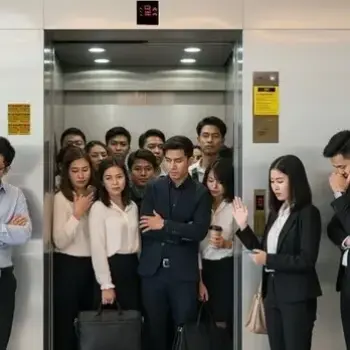


The Social Disease of Power-Hungry for Funds in Residential Communities
In various residential communities, such as neighborhood associations (RT/RW/P3SRS), we often hear and see decisions with the slogan "From Us, For Us."
But there's no planning. No meetings. No deliberations. No budget approvals. No open reports.
There are only decisions made, events made, and a narrative that everyone agrees.
If the forum is eliminated but claims of togetherness are still used, that's not mutual cooperation.
It's a concentration of power disguised as rhetoric. This social ill has been around for a long time, with an old theme, but it remains effective in hypnotizing residents about their rights and obligations, as well as the values of transparency and accountability.
Also read other articles:
It sounds warm. It sounds collaborative. It sounds collective.
But let's peel back the rhetoric.
Where are the meetings?
Where are the minutes?
Where is the budget approval?
Where is the accountability report?
If all of that is missing, then all that remains is the use of the word "we" without our presence.
The consequences are:
Today, consumption without a meeting.
Tomorrow, contributions without approval.
The day after tomorrow, policies without a mandate.
All in the name of "we."
Yet, "we" are never given the space to express agreement or disagreement.
This is a dangerous phase in a community: the normalization of unilateral decisions.
When residents become silent, not because they agree, but because they don't understand the process and are tired of asking questions.
If the collective process is eliminated but the collective name remains, that is not togetherness.
That is a usurpation of legitimacy.
This phenomenon is not just about activities and/or eating. It is a symptom of a social disease that indicates:
- Infatuated with social status.
- Thirst for recognition.
- Thirst for power on a micro scale.
- Thirst for managing funds without overt control.
When community positions are used as platforms for identity, deliberation is seen as an obstacle.
When community funds are seen as a control area, transparency is seen as a threat.
This is despite Indonesian legal norms clearly establishing the principles of deliberation and accountability as foundational.
Deliberation is not a formality, but a source of decisions.
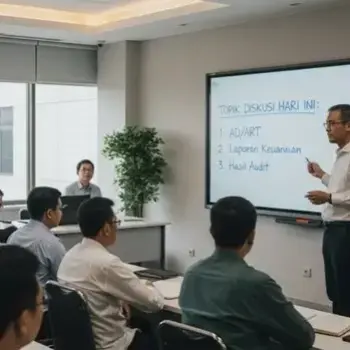
Every decision concerning residents is not born from jargon, but from deliberation. This principle is emphasized in Ministerial Regulation No. 4 of 2025 on PKP, which clearly positions the member deliberation as the highest decision-making forum in the PPPSRS. Furthermore, Chapter IV, Article 39, explicitly regulates the rights of resident owners.
Therefore, when an activity suddenly appears labeled "from us for us" without prior deliberation, without a financial plan, without an agenda, without outreach, without a quorum, and without member approval, the decision is flawed from the outset. This is not due to malicious intent, but because it bypasses the required mechanisms.
Deliberation is not an obstacle to good deeds, but rather a tool for legitimacy and collective protection. It is where plans are disclosed, budgets are reviewed, and approvals are granted. Without it, residents are not invited to participate, but are instead faced with a pre-determined decision.
If an activity is truly "from us, for us," then it should be discussed by us, approved by us, and decided by us, through legitimate, open, and quorum-based deliberation. Without deliberation, jargon is merely empty words, not binding decisions.
So what happens:
Today, an event without a meeting.
Tomorrow, contributions without approval.
The day after tomorrow, policies without a mandate.
Also read other articles:
All wrapped up in an old song with one sacred line: 'For all of us.'
Yet the simplest question has never been answered:
Have "we" ever been consulted?
A healthy community isn't allergic to forums.
Legitimate power isn't afraid of questions.
Clean fund managers aren't afraid of open reporting.
The danger isn't the event itself.
The danger is the normalization of unilateral decisions.
Because when this social ill is left unchecked, what's lost isn't just money for consumption.
What's lost is trust.
It would be more honest to say:
- "From you, for our version of the program," or
- "From you, for your satisfaction."
And a community without trust is just a soulless structure, accompanied by a disease of thirst that is always hungry for power.
FAQ
1. Does every activity require a meeting?
If it uses the community name and involves shared funds, a meeting or approval mechanism is a basic form of legitimacy.
2. Can questioning transparency be considered provocative?
No. Transparency is a principle of good governance and actually protects administrators from suspicion.
3. What are the risks if unilateral decisions are allowed to take place?
It could create a culture of closed power that could potentially extend to fund management and strategic policies.
4. Does the law regulate the importance of member meetings?
Yes. In the context of residential communities and P3SRS, laws and regulations place member meetings as the highest authority.
5. How can social ills be prevented in the community?
Strengthen a culture of deliberation, document decisions, disclose financial reports, and activate community social control. If there are indications of irregularities that occur repeatedly and over a significant period of time, these indications should be reported to the authorities or higher-level supervisors.
6. How can we identify indications of irregularities?
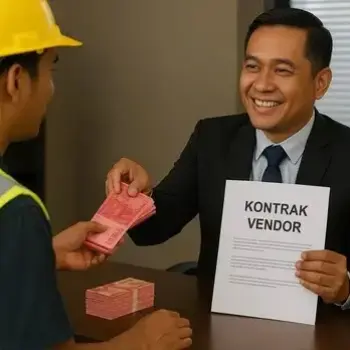
There are many ways to do this, such as: Pay attention to the recipient's account number; it's usually an individual or couple's account, and not an organization's account. You can also check to see if the financial manager has a steady job or income. There are various other more productive and collaborative methods, without accusations.
Read other articles too:
- The Mystery of Invisible Power in Community Management
- Project Transparency in the Community
- The Role of Buzzers in the Community